Insights and advocacy for workplace accommodation
Welcome to the Accomodation Rights blog, where we share valuable information and support for workers facing disabilities in the workplace. Our mission is to educate, empower, and advocate for your rights.

Understanding your workplace rights
Our blog focuses on helping workers with disabilities better understand their workplace rights, accommodation processes, and safety protections. We provide guidance on navigating difficult workplace situations with confidence, awareness, and proper documentation. We cover real-life challenges including physical injuries, mental health conditions like PTSD, anxiety, depression, and invisible disabilities. Learn about return-to-work issues, discrimination, unsafe work environments, and the critical importance of preparation, organization, and protecting your rights through professional communication and documentation. We also share real worker experiences, practical guidance, and educational content that promotes dignity, fairness, accountability, and a stronger understanding of accommodation rights. In honour of Riley, a service dog who gave her life protecting her human, we also raise awareness about the rights of service animals and the people who depend on them.

Who our blog helps
Our blog is primarily for workers, injured workers, people with disabilities, individuals facing workplace barriers, and those trying to understand their accommodation and human rights. We aim to support those who may feel confused, isolated, overwhelmed, or unheard while navigating workplace injuries, mental health challenges, return-to-work processes, discrimination, or accommodation issues. We also hope employers, supervisors, advocacy groups, unions, legal professionals, healthcare providers, policymakers, and community supporters will read our content to better understand the real human impact behind workplace accommodation and safety issues. Our goal is to encourage awareness, accountability, respectful communication, and better outcomes for everyone involved, creating a more inclusive and equitable workplace for all.

Empowering action and understanding
After reading our blog posts, we hope you feel informed, empowered, prepared, and less alone in what you are going through. We want workers to better understand their rights, take their safety and documentation seriously, speak up when something is wrong, and feel confident seeking proper accommodation and support. We also hope readers begin thinking more critically about workplace safety, fairness, mental health, disability awareness, and the importance of treating every person with dignity and respect. Most importantly, we want people to take action — whether that means protecting themselves, supporting others, improving workplace practices, or helping create a safer and more understanding environment for everyone.
Message from Milo the missing "M"
The missing "M"
WORKPLACE SAFETY, PREPARATION & PROTECTING YOUR RIGHTS
Your Safety Starts Before Your Shift Begins
Every worker deserves to return home safe.
Safety is not just a workplace policy — it is a personal responsibility to yourself, your health, and your loved ones. Protection starts from day one. The way you prepare, communicate, document, and carry yourself at work can protect your future, your rights, and your family.
- Being prepared is not weakness.
- Being organized is not overreacting.
- Being careful is not negativity.
It is smart. It is responsible. It is necessary.
1. PREPARATION IS YOUR FIRST LAYER OF PROTECTION
“90% preparation, 10% execution.”
Most workplace mistakes, injuries, confusion, and conflicts happen when workers are rushed, exhausted, distracted, unprepared, or unclear about expectations.
Before your shift starts:
- Get proper sleep and rest
- Leave home early
- Arrive at work early
- Avoid rushing
- Prepare mentally and physically
- Know your tasks and responsibilities
- Review safety procedures
- Ensure you have the right equipment, tools, and information
Arrive Early — Not Exactly On Time
Being “on time” should mean being fully ready to begin work, not walking through the door at the scheduled start time.
Give yourself enough time to:
- Settle in
- Organize yourself
- Review duties
- Understand the work environment
- Identify possible safety concerns
- Prepare properly without stress or panic
A rushed worker is more likely to:
- Make mistakes
- Miss hazards
- Forget procedures
- Suffer injuries
- Miscommunicate
- Become mentally overwhelmed
2. TAKE OWNERSHIP OF YOUR RESPONSIBILITIES
- Blaming others is easy.
- Real protection begins when you take ownership of:
- Your preparation
- Your awareness
- Your communication
- Your professionalism
- Your safety practices
- Your documentation
This does not mean accepting unsafe treatment or unfair behavior.
It means understanding that protecting yourself starts with your own actions, awareness, and discipline.
Smart workers:
- Stay calm
- Stay organized
- Think before reacting
- Ask questions when unclear
- Avoid unnecessary conflict
- Keep records
- Remain professional under pressure
3. YOU HAVE THE RIGHT TO REFUSE UNSAFE WORK
If you genuinely believe work is unsafe or dangerous, you have the right to speak up.
Never ignore:
- Unsafe equipment
- Missing training
- Unsafe instructions
- Dangerous conditions
- Improper procedures
- Serious hazards
- Work beyond your physical or medical limitations
Important reminders:
- Report concerns professionally
- Stay calm and respectful
- Document what happened
- Keep records of conversations and responses
- Follow workplace reporting procedures where possible
- Speaking up about safety is not weakness.
- Protecting your life matters.
4. DOCUMENT EVERYTHING
- Documentation protects your rights.
- One of the biggest mistakes workers make is trusting memory alone.
- People may later:
- Forget conversations
- Change statements
- Deny discussions
- Rewrite timelines
- Misinterpret events
- Shift responsibility
Clear documentation can protect:
- Your credibility
- Your job
- Your injury claim
- Your accommodation needs
- Your legal rights
- Your family’s future
5. WHAT YOU SHOULD DOCUMENT
- Keep records of:
- Workplace incidents
- Injuries
- Near misses
- Unsafe conditions
- Equipment failures
- Safety concerns
- Communication
- Meetings
- Instructions
- Verbal conversations
- Phone calls
- Warnings
- Changes in duties
- Medical or accommodation-related issues
- Restrictions
- Requests
- Modified duties
- Symptoms
- Medical appointments
- Recommendations
- Employment matters
- Schedule changes
- Discipline
- Performance concerns
- Workload issues
- Return-to-work discussions
6. USE EMAILS TO PROTECT YOURSELF
If something important happens and you cannot document it immediately:
- Send a follow-up email.
- A professional follow-up email can help:
- Confirm facts
- Create timelines
- Prevent misunderstandings
- Preserve evidence
- Protect accountability
Good practices:
- Stay professional
- Stick to facts
- Include dates and times
- Be clear and specific
- Avoid emotional language
- Save copies of important emails
- Where appropriate, copy another person for transparency
7. REMAIN PROFESSIONAL — BUT STAY ALERT
Many workplaces genuinely care about employee safety and wellbeing. Many supervisors and coworkers work hard to support workers properly.
At the same time, workers should still protect themselves professionally and responsibly.
- Watch for warning signs such as:
- Safety concerns being ignored
- Verbal promises without follow-through
- Important discussions not being documented
- Pressure to stay silent
- Lack of transparency
- Unequal accountability
- Inconsistent communication
- Retaliation after reporting concerns
8. WORDS DO NOT MATTER MORE THAN ACTIONS
Professional language can sound comforting:
- “We care.”
- “You’re valued.”
- “Safety comes first.”
- “We support you.”
Good words are important — but actions, policies, accountability, and documented behavior matter far more.
- Always pay attention to:
- What is documented
- What actions are taken
- Whether concerns are addressed properly
- Whether safety procedures are actually followed
- Never rely only on verbal reassurance.
9. STAY CALM, SMART, AND ORGANIZED DURING CONFLICT
- If conflict happens:
- Stay calm
- Do not panic
- Avoid emotional reactions
- Avoid aggressive communication
- Focus on facts
- Keep records
- Ask for clarification in writing where possible
- Protect your professionalism
Remember:
- Professionalism is protection.
- The calmer and more organized you remain, the stronger your position becomes.
10. RESPECT EVERYONE — BUT PROTECT YOURSELF
- Treat everyone with professionalism and respect.
- But also remember:
- Respect should not mean silence
- Kind words should not replace accountability
- Trust should not replace documentation
- Professionalism should not replace awareness
- You can be respectful while still protecting your rights.
FINAL MESSAGE
- Prepare yourself.
- Protect yourself.
- Document everything.
- Know your rights.
- Stay professional.
- Stay organized.
- Stay aware.
- Your safety matters.
- Your health matters.
- Your future matters.
- And every worker deserves to make it home safely.

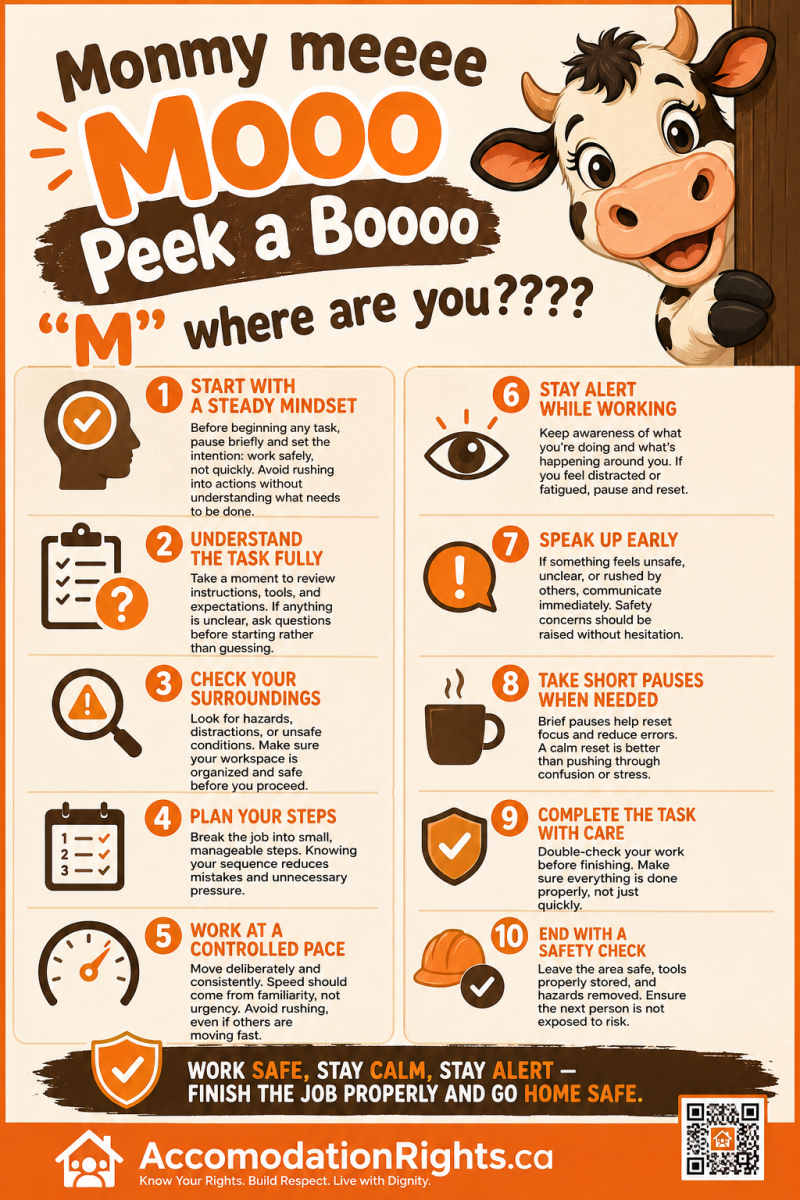
Best Practice: Safe, Calm, and Alert Work Approach
1. Start with a steady mindset Before beginning any task, pause briefly and set the intention: work safely, not quickly. Avoid rushing into actions without understanding what needs to be done.
2. Understand the task fully Take a moment to review instructions, tools, and expectations. If anything is unclear, ask questions before starting rather than guessing.
3. Check your surroundings Look for hazards, distractions, or unsafe conditions. Make sure your workspace is organized and safe before you proceed.
4. Plan your steps Break the job into small, manageable steps. Knowing your sequence reduces mistakes and unnecessary pressure.
5. Work at a controlled pace Move deliberately and consistently. Speed should come from familiarity, not urgency. Avoid rushing, even if others are moving fast.
6. Stay alert while working Keep awareness of what you’re doing and what’s happening around you. If you feel distracted or fatigued, pause and reset.
7. Speak up early If something feels unsafe, unclear, or rushed by others, communicate immediately. Safety concerns should be raised without hesitation.
8. Take short pauses when needed Brief pauses help reset focus and reduce errors. A calm reset is better than pushing through confusion or stress.
9. Complete the task with care Double-check your work before finishing. Make sure everything is done properly, not just quickly.
10. End with a safety check Leave the area safe, tools properly stored, and hazards removed. Ensure the next person is not exposed to risk.
Core principle:
Work safe, stay calm, stay alert — finish the job properly and go home safe.
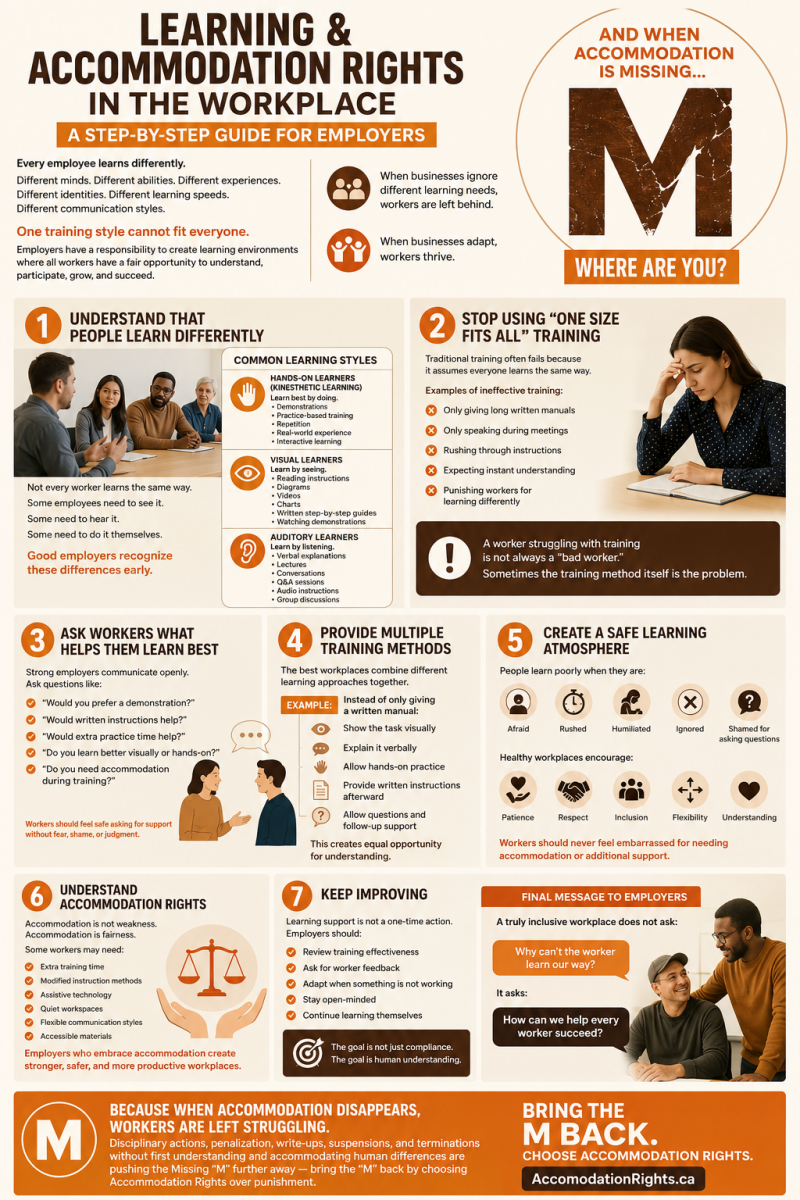
Learning & Accommodation Rights in the Workplace
A Step-by-Step Guide for Employers
Every employee learns differently.
Different minds. Different abilities. Different experiences. Different identities. Different learning speeds. Different communication styles.
A successful workplace understands this simple truth:
One training style cannot fit everyone.
Employers have a responsibility to create learning environments where all workers have a fair opportunity to understand, participate, grow, and succeed.
When businesses ignore different learning needs, workers are left behind.
- When businesses adapt, workers thrive.
- And when accommodation is missing…
M where are youuuuuu???
Step 1: Understand That People Learn Differently
- Not every worker learns the same way.
- Some employees need to see it.
- Some need to hear it.
- Some need to do it themselves.
- Good employers recognize these differences early.
Common Learning Styles
1. Hands-On Learners (Kinesthetic Learning)
These workers learn best by physically doing the task themselves.
They benefit from:
- Demonstrations
- Practice-based training
- Repetition
- Real-world task experience
- Interactive learning
2. Visual Learners
- These workers learn by seeing information.
- They benefit from:
- Reading instructions
- Diagrams
- Videos
- Charts
- Written step-by-step guides
- Watching demonstrations
3. Auditory Learners
- These workers learn by listening and discussing.
- They benefit from:
- Verbal explanations
- Lectures
- Conversations
- Question-and-answer sessions
- Audio instructions
- Group discussions
Step 2: Stop Using “One Size Fits All” Training
Traditional training often fails because it assumes everyone learns the same way.
- Examples of ineffective training:
- Only giving long written manuals
- Only speaking during meetings
- Rushing through instructions
- Expecting instant understanding
- Punishing workers for learning differently
A worker struggling with training is not always a “bad worker.”
Sometimes the training method itself is the problem.
Step 3: Ask Workers What Helps Them Learn Best
- Strong employers communicate openly.
- Ask questions like:
- “Would you prefer a demonstration?”
- “Would written instructions help?”
- “Would extra practice time help?”
- “Do you learn better visually or hands-on?”
- “Do you need accommodation during training?”
Workers should feel safe asking for support without fear, shame, or judgment.
Step 4: Provide Multiple Training Methods
The best workplaces combine different learning approaches together.
Example:
Instead of only giving a written manual:
✔ Show the task visually
✔ Explain it verbally
✔ Allow hands-on practice
✔ Provide written instructions afterward
✔ Allow questions and follow-up support
This creates equal opportunity for understanding.
Step 5: Create a Safe Learning Atmosphere
People learn poorly when they are:
- Afraid
- Rushed
- Humiliated
- Ignored
- Shamed for asking questions
Healthy workplaces encourage:
- Patience
- Respect
- Inclusion
- Flexibility
- Understanding
Workers should never feel embarrassed for needing accommodation or additional support.
Step 6: Understand Accommodation Rights
- Accommodation is not weakness.
- Accommodation is fairness.
- Some workers may need:
- Extra training time
- Modified instruction methods
- Assistive technology
- Quiet workspaces
- Flexible communication styles
- Accessible materials
Employers who embrace accommodation create stronger, safer, and more productive workplaces.
Step 7: Keep Improving
- Learning support is not a one-time action.
- Employers should:
- Review training effectiveness
- Ask for worker feedback
- Adapt when something is not working
- Stay open-minded
- Continue learning themselves
- The goal is not just compliance.
The goal is human understanding.
Final Message to Employers
A truly inclusive workplace does not ask:
Why can’t the worker learn our way?
It asks:
How can we help every worker succeed?
Because when accommodation disappears, workers are left struggling.
Let’s bring the Missing M back into Accommodation Rights.
Disciplinary actions, penalization, write-ups, suspensions, and terminations without first understanding and accommodating human differences are pushing the Missing “M” further away — bring the “M” back by choosing Accommodation Rights over punishment.
Understanding "Finding the Missing M" in Practic
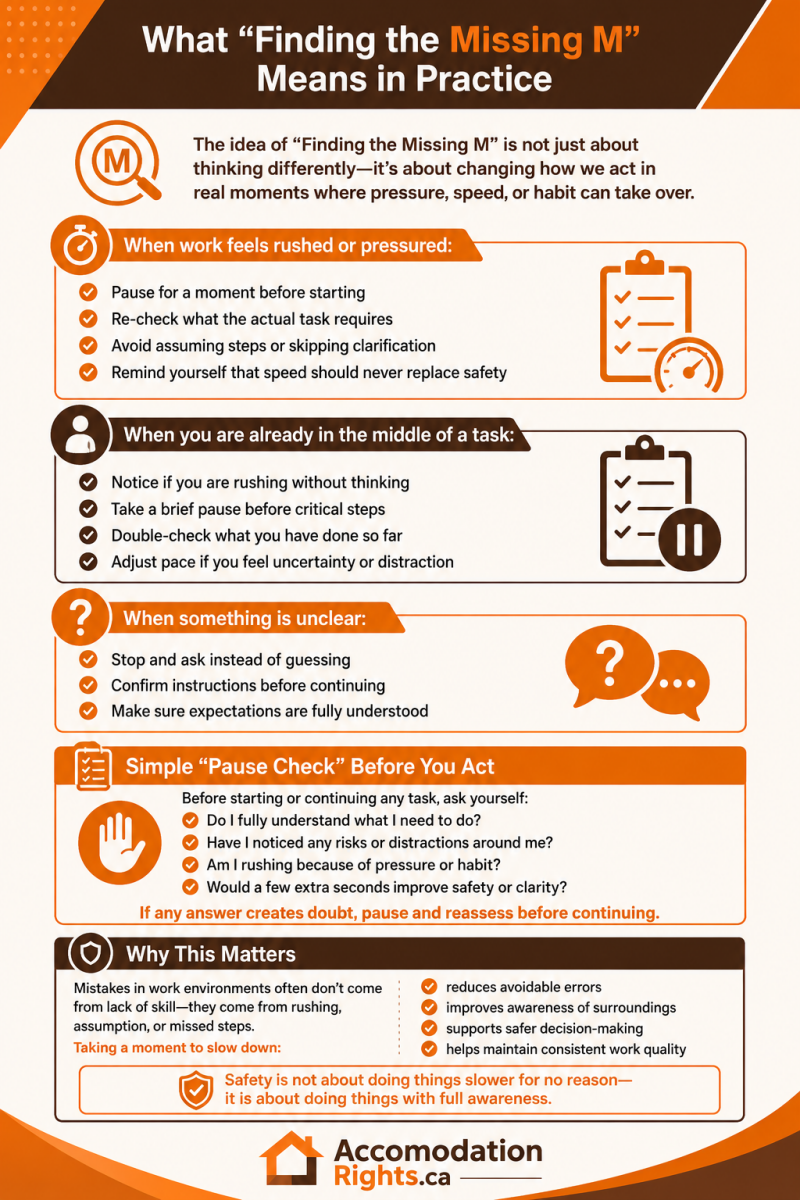
The concept of "Finding the Missing M" is not merely about adopting a different mindset; it’s about transforming our actions in real-world situations where pressure, speed, or ingrained habits can dominate.
1. Pause before starting any task.
2. Understand exactly what the job requires.
3. Do not rush because of pressure or habit.
4. Never let speed reduce safety.
5. Avoid assumptions or guessing.
6. Ask questions if instructions are unclear.
7. Check your surroundings for hazards or distractions.
8. Stay mentally focused while working.
9. Notice if you are rushing without thinking.
10. Pause before important or critical steps.
11. Review what you have completed so far.
12. Slow down if you feel distracted or uncertain.
13. Verify instructions before continuing.
14. Make sure expectations are fully understood.
15. Before acting, ask yourself:
Do I understand the task?
- Are there risks or distractions?
- Am I rushing?
- Would a few extra seconds improve safety or clarity?
16. If something feels uncertain, stop and reassess first.
17. Remember: most workplace mistakes happen because of rushing, assumptions, or skipped steps.
18. Slowing down helps prevent mistakes and improves awareness.
19. Careful actions lead to safer and better-quality work.
20.Safety means working with full awareness, not unnecessary delay.