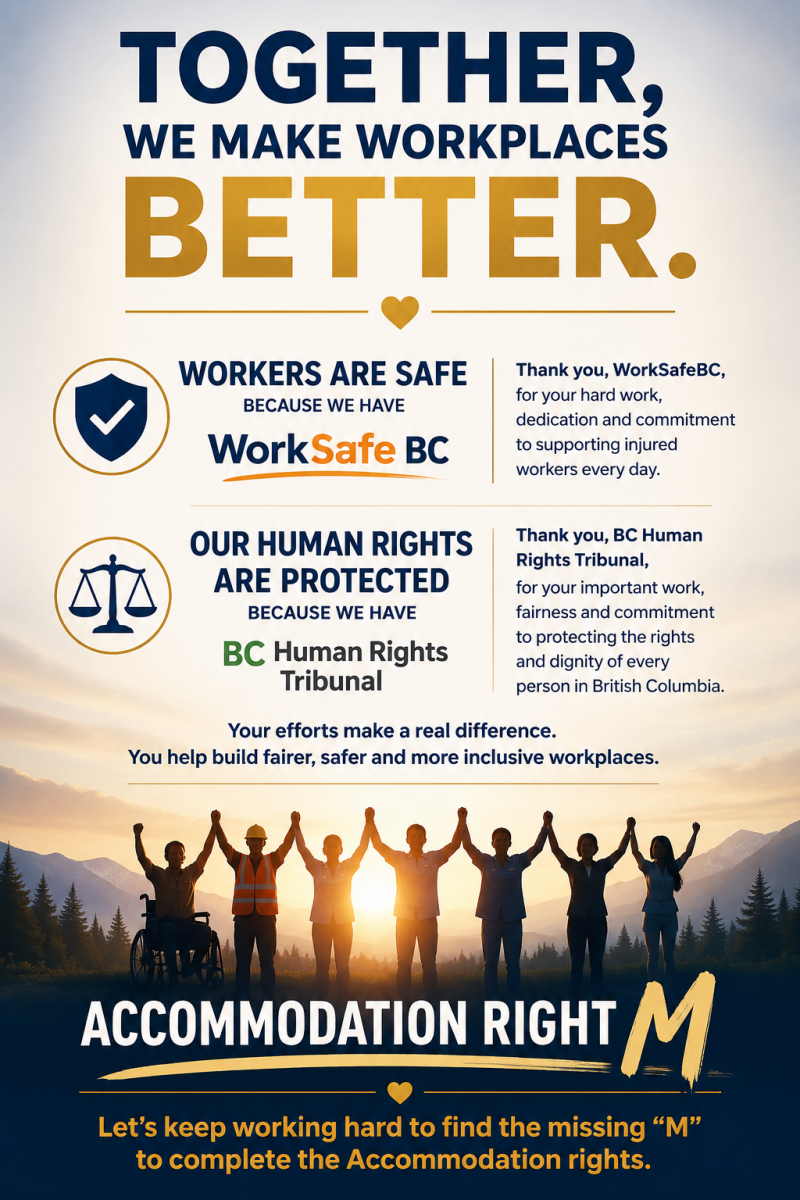
Your guide to workplace rights, accommodation, and fair resolution in British Columbia
Navigating workplace challenges can be complex, especially when dealing with injuries or accommodation needs. This page provides clarity on the established systems and support available to you in British Columbia.

Understanding your rights in British Columbia
In British Columbia, there are established, credible systems designed to support workers' health, safety, and human rights, making them accessible when you need help. This page aims to help you understand that while every situation is unique, our province has trusted institutions that exist to guide workers through challenges, ensure fair consideration of their needs, and support more inclusive and respectful workplaces.

WorkSafeBC: Supporting injured workers and promoting safety
WorkSafeBC provides structured support for injured workers, including recovery assistance, rehabilitation, and return-to-work planning, while promoting safer workplaces across the province. Their framework is designed to bring structure and clarity to situations that can often feel overwhelming, offering organized pathways for recovery support, rehabilitation, and workplace safety guidance. This invaluable service ensures that workers can focus on healing and returning to work safely and effectively.

The BC Human Rights Tribunal: Ensuring fairness and impartiality
The BC Human Rights Tribunal plays an important role in offering a fair, impartial process for addressing discrimination concerns and upholding human rights protections. It is designed to ensure that all individuals are treated with dignity and fairness, providing a crucial avenue for redress when human rights are violated. The Tribunal’s framework helps to ensure fair, balanced, and impartial resolution of human rights concerns, reinforcing the commitment to equality in the workplace and beyond.
Who this page helps
This page primarily focuses on supporting workers, especially those who are injured or require workplace accommodations due to physical or psychological health conditions. It is designed to help you understand the support systems available in British Columbia, empowering you to navigate workplace challenges, recovery, or accommodation needs with greater confidence.
Additionally, this information benefits employers by promoting awareness of their responsibilities and encouraging constructive, proactive engagement with accommodation and return-to-work processes. By understanding the roles of WorkSafeBC and the BC Human Rights Tribunal, we can foster a culture of understanding and cooperation across workers, employers, and legal professionals.
Overcoming common challenges
Many people encounter workplace rights and accommodation issues during stressful and uncertain times. Common difficulties include not knowing what supports are available, how to clearly explain accommodation needs, or feeling overwhelmed by delays and misunderstandings. In these situations, having structured, established systems becomes especially important.
Institutions like WorkSafeBC play a crucial role by providing organized pathways for recovery support, rehabilitation, workplace safety guidance, and return-to-work coordination. They bring structure and clarity to complex situations, helping to reduce stress and facilitate positive outcomes for all involved.
Next steps: gain clarity and seek support
After reading this page, our main goal is for you to feel more informed and confident about your workplace rights, accommodation options, and the structured pathways available to support you in British Columbia. You should feel better able to communicate your needs and more aware of how to engage constructively with existing systems when challenges arise.
If you need further support or clarification, please reach out through our contact information. We can help direct you toward appropriate resources or next steps based on your specific situation. We are proud to highlight the important roles that WorkSafeBC and the BC Human Rights Tribunal play in supporting workers through recovery, safety, and fair resolution processes.